In our increasingly connected world, keeping devices powered is a constant necessity. From smartphones to laptops, tablets to smartwatches, reliable charging is paramount. But navigating the array of charging cables and power adapters can feel overwhelming. Are they the same thing? How do you choose the right ones without damaging your devices or wasting money? This comprehensive guide will demystify the world of charging, helping you understand the crucial differences and make informed decisions for a safer, faster, and more efficient power experience.
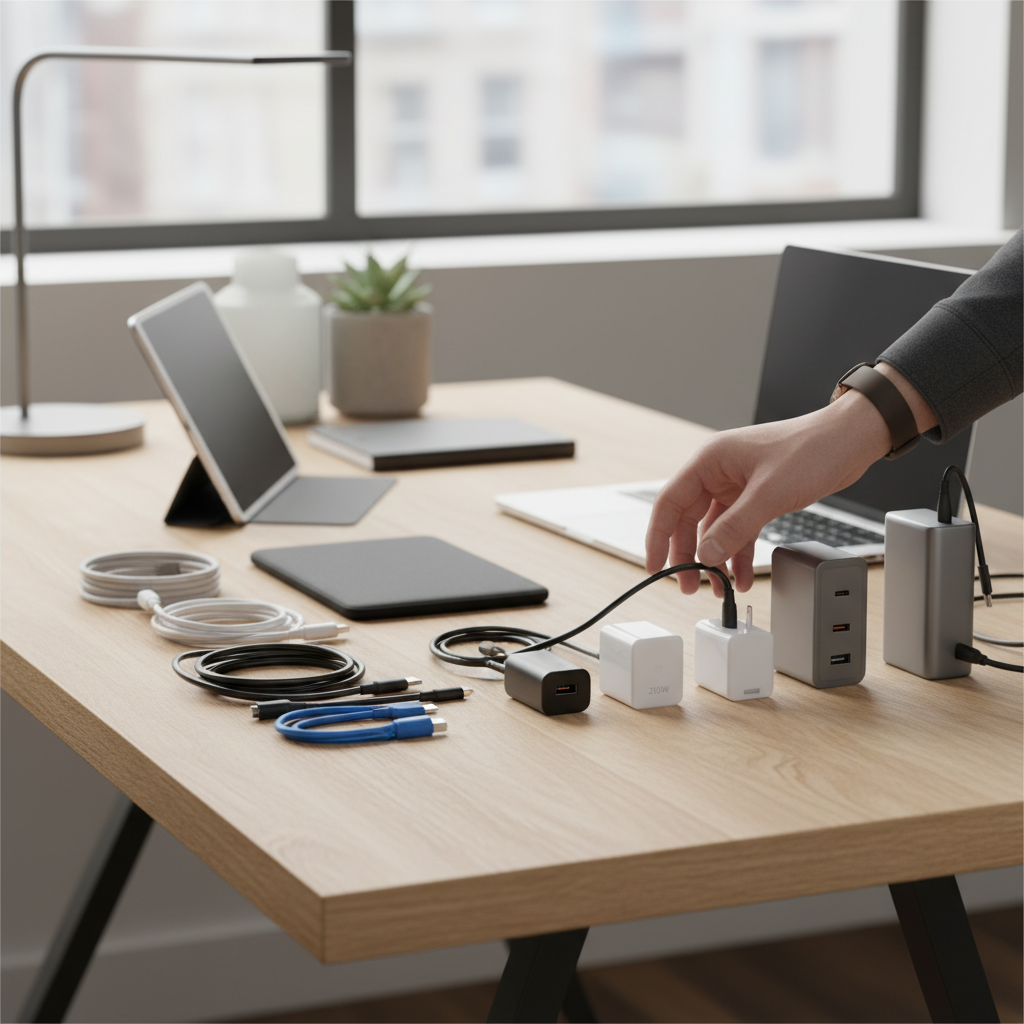
Charging Essentials: Cables and Power Adapters Explained
Understanding the distinct roles of charging cables and power adapters is the first step toward building an optimal charging setup. While often used interchangeably, these components serve different, yet complementary, functions in delivering power to your electronics.
Power Adapters: The Wall-Side Powerhouse
|
Our Picks for the Best Charging cable in 2026
As an Amazon Associate I earn from qualifying purchases.
|
||
| Num | Product | Action |
|---|---|---|
| 1 | LISEN USB C to USB C Cable, 240W C to C Cable Fast Charging [6.6FT, 2 Pack] Type C Charger Fast Charging USBC to USBC Cable for iPhone 17 16 15 Pro Max iPad MacBook Neo Air Pro Samsung S26 S25 Ultra |
![Check LISEN USB C to USB C Cable, 240W C to C Cable Fast Charging [6.6FT, 2 Pack] Type C Charger Fast Charging USBC to USBC Cable for iPhone 17 16 15 Pro Max iPad MacBook Neo Air Pro Samsung S26 S25 Ultra on Amazon](https://reviewasc.com/wp-content/plugins/amazon-tables/assets/images/buy.png)
|
| 2 | AINOPE USB to USB C Cable [2-Pack, 6.6ft] 3.1A Type C Charger Fast Charging, Right Angle USB C Cable for iPhone 17 Carplay Cable, Galaxy S10+ S10 S9, Note 10 9, LG V30, Moto, iPhone 16 15 Charger Cord |
|
| 3 | Anker Cable [2 Pack 6ft], USB A to USB C Cable for iPhone 17 Series,Samsung Galaxy S10 S10+, LG V30, Beats Fit Pro and More (Black). |
|
| 4 | Durcord USB C Cable, Upgarded 2Pack 10ft Fast USB Type C Charging Cable for Android/Phone/Pad/Laptop, Type C Charger Braided USB Cable Compatible withi Phone 17/16/15/Pro/Plus/Max/Sam.Sung-Silver |
|
| 5 | Anker USB C to USB C Cable, Type-C 60W Fast Charging Cable (6 FT, 2Pack) for iPhone 17 Series, iPad mini 6 and More (Black) |
|
| 6 | iPhone Charger 3 Pack 10 ft Apple MFi Certified Lightning Nylon Braided Cable Fast Charging Cord Compatible with iPhone 13 12 11 Pro Max XR XS X 8 7 6 Plus SE iPad and More |
|
| 7 | LISEN USB C to USB C Cable, 5-Pack [3.3/3.3/6.6/6.6/10FT] for iPhone 17 Charger Cord, 60W C to C Cable Fast Charging for iPad, iPhone 16 15 Pro Max, Galaxy S25/S24 USBC to USBC Cable Gifts for Men |
|
| 8 | INIU USB C to USB C Cable, 240W Fast Charging Type C Charger Cord, Braided USBC Phone Charger Cable for iPhone 17 16 Pro Max Samsung S26 S25 Laptops MacBook Air 15 M3 iPad Switch [6.6ft+6.6ft Black] |
|
| 9 | USB Type-C to A Cable 5pack 6ft Braided Fast Charging 3A Quick Charger Cord, 6 Foot Compatible iPhone 17/17 Pro/16e/16/15 Pro Max,Samsung Galaxy S10 S9 S8 Plus, Note 10 9 8, LG V50 V40 G8 G7(Grey) |
|
| 10 | Teeind USB Type C Cable Fast Charging, Tpc001 5 Pack(6Ft 3A) Braided C Charger Cables Compatible with Samsung S10e/note 9/s10/s9/s8 Plus/A80/A50/A20 |
|
A power adapter, also known as an AC adapter or power brick, is the primary unit that plugs into a wall outlet. Its fundamental job is to convert the high-voltage Alternating Current (AC) from the mains electricity into the low-voltage Direct Current (DC) that your electronic devices require. Think of it as a crucial translator for electricity. These adapters often contain internal components like transformers and rectifiers to manage this conversion and regulate the voltage to a safe, steady level.
Power adapters are designed to supply continuous power to devices, whether they have a battery or not. For instance, routers, monitors, and many older laptops rely on a power adapter to run. While an adapter can also facilitate battery charging in devices, the intricate process of replenishing the battery itself—managing voltage, current, and charge cycles—is typically handled by the device’s internal Battery Management System (BMS). A key characteristic of a general power adapter is its fixed output voltage and amperage, which must precisely match the device’s requirements to function correctly and safely.
Charging Cables: The Device Link
The charging cable is the physical link that connects your device to the power adapter or another power source, like a computer’s USB port. It’s responsible for transmitting the converted DC power and, in many cases, facilitating data transfer between devices. Cables come in various connector types, each designed for specific devices and often offering different capabilities in terms of power delivery and data speed.
The evolution of charging cables has been rapid, driven by the demand for faster charging and universal compatibility. Older cable types have given way to more advanced ones that can handle higher wattages and offer reversible connections. Understanding these different types is essential for ensuring your devices receive power efficiently and safely.
Key Factors When Choosing Your Charging Setup
Selecting the right charging cable and power adapter is more than just grabbing any available option. Several critical factors influence compatibility, safety, and performance. Paying attention to these details can significantly impact your device’s battery health and charging speed.
Power Output and Charging Speed (Wattage)
The power output of a charger, measured in watts (W), directly dictates how quickly your device will charge. Different devices have varying power requirements: smartphones typically charge between 18W and 30W, tablets might need 20W to 45W, and laptops often demand 45W to over 100W, depending on their model and usage.
It is crucial to match the power adapter’s wattage to your device’s needs. While a higher wattage adapter is generally safe for a lower wattage device (as the device will only draw the power it requires), using an adapter with insufficient wattage for a demanding device can lead to slow charging, overheating of the adapter, or even damage to the charging components. Look for fast charging standards like Power Delivery (PD) for USB-C devices or Quick Charge, which dynamically adjust power delivery for optimal speed.
[image-1|charging-speed-wattage-comparison|Illustrative chart showing different device types and their typical wattage requirements for charging.|
An infographic displaying typical wattage requirements for various electronic devices like smartphones, tablets, and laptops, with corresponding charging speed indicators. The style should be clean, modern, and illustrative with clear labels and a focus on power output in watts.]
Connector Compatibility and Port Types
The physical connectors on both your cable and power adapter must match your device’s charging port. This is a fundamental aspect of compatibility.
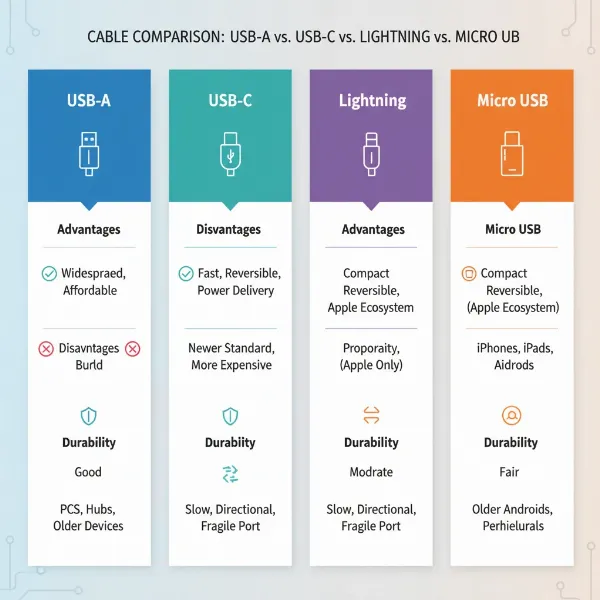
- USB-C: Emerging as the universal standard, USB-C offers a reversible connector, meaning there’s no “wrong way” to plug it in. It supports high power delivery (Power Delivery standard) and fast data transfer, making it ideal for modern smartphones, tablets, and laptops. Not all USB-C cables are created equal; some are rated for higher wattages than others.
- Lightning: Apple’s proprietary connector, used primarily for iPhones (up to iPhone 14), iPads, and other Apple accessories. Like USB-C, it is reversible and supports fast charging with compatible power adapters. Newer Apple devices (iPhone 15 and later) have transitioned to USB-C.
- Micro-USB: Once a ubiquitous standard for Android phones and many other portable electronics, Micro-USB is now largely found on older devices, budget gadgets, and accessories like Bluetooth speakers. It is not reversible and generally offers slower charging speeds.
- USB-A: This is the classic, rectangular USB connector, still common on many power adapters and computers. Cables often feature a USB-A connector on one end and another type (like USB-C, Lightning, or Micro-USB) on the device end.
For Apple devices, look for MFi-certified (Made for iPhone/iPad) accessories to ensure full compatibility and performance. For general USB standards, USB-IF certified products indicate adherence to industry specifications, promoting safety and reliability.
Cable Material and Durability
The material and construction of your charging cable significantly impact its longevity and resistance to wear and tear. A flimsy cable can fray, break, or cease functioning quickly, leading to constant replacements.
- PVC (Polyvinyl Chloride): A common, cost-effective material, but often less flexible and prone to cracking or fraying over time, especially at stress points near the connectors.
- TPE (Thermoplastic Elastomer): More flexible and durable than PVC, TPE cables often feel softer and are more resistant to kinks and tangles.
- Nylon Braided: Considered among the most durable options, nylon braided cables feature an outer layer of woven nylon. This construction makes them highly resistant to tangles, bends, and general wear, offering a longer lifespan.
Investing in a high-quality, durable cable can save you money and frustration in the long run. Proper cable care, such as avoiding sharp bends and unplugging by the connector rather than yanking the cable, can also extend its lifespan.
Length and Design
While often overlooked, the length and specific design features of your charging cable and adapter can greatly enhance convenience and utility.
- Cable Length: Choose a length that suits your usage. A short cable (e.g., 0.3-0.5 meters) is excellent for portability or connecting to a laptop. A standard length (e.g., 1-1.2 meters) is versatile for most everyday scenarios. Longer cables (e.g., 2-3 meters) offer flexibility when outlets are far away, but can also be more prone to tangling and may experience slight power loss over very long distances.
- Adapter Design: Some power adapters are compact with foldable plugs, making them ideal for travel. Others may feature multiple USB ports, allowing you to charge several devices simultaneously from a single outlet, reducing clutter. Features like LED indicators on cables or adapters can also be helpful for quickly checking charging status.
A Closer Look: Comparing Charging Components
To further clarify the distinction and help you choose, let’s compare the key features of power adapters and charging cables in detail.
Table: Charger Types vs. Adapter Features
| Feature | Power Adapter (General Purpose) | Charger (Battery-Focused) |
|---|---|---|
| Primary Function | Converts AC to DC; powers device continuously | Converts AC to DC; intelligently manages battery charging |
| Charging Logic | Minimal/None; device’s BMS handles battery charging | Intelligent circuitry; follows charging algorithms (e.g., CC/CV) |
| Output | Fixed voltage and amperage output | Variable voltage and amperage during different charging phases |
| Size | Can be larger due to power conversion components | Often more compact but contains sophisticated control circuits |
| Risk with Batteries | Can damage battery if used directly without device’s BMS | Optimizes battery health, prevents overcharging and overheating |
| Examples | Router power supply, monitor power brick | Wall brick for smartphones/laptops, battery chargers |
Table: Common Charging Cable Types
| Criteria | USB-A | USB-C | Lightning | Micro USB |
|---|---|---|---|---|
| Pros | Widespread, affordable, universal for older devices | Reversible, fast charging (PD), versatile for power and data, high data speed | Apple device compatibility, reversible, good for older Apple devices | Common for many older Android devices and accessories, compact connector |
| Cons | Non-reversible, slower speeds, limited power delivery capabilities | Can be more expensive, not all USB-C cables support maximum features (e.g., high wattage PD) | Proprietary (Apple only), generally more expensive | Non-reversible, slowest speeds, less durable connector, prone to damage |
| Max Power | Low (typically up to 12W) | High (up to 100W+ commonly, newer standards up to 240W) | Moderate (up to 20-30W for fast charging with compatible adapter) | Low (typically up to 10-12W) |
| Durability | Varies widely by material and construction | Varies by material and construction, often found with braided options | Varies by material and construction, generally robust | Prone to wear and bending at the connector, less durable overall |
“The core difference lies in their intelligence. A power adapter simply provides electricity; a charger intelligently interacts with a battery’s chemistry to optimize its charge cycle and longevity.”
Buying Guide: Making the Right Choice
With a clearer understanding of charging components, here’s a step-by-step guide to help you choose the best charging cable and power adapter for your needs.
Assess Your Device’s Needs
Start by understanding what your device truly requires. Check the original charger, the device’s user manual, or its specifications online. Look for:
- Port Type: Does your device use USB-C, Lightning, Micro-USB, or another proprietary connector?
- Voltage (V) and Amperage (A): The output voltage of your power adapter must exactly match your device’s input voltage. The amperage (current) should be equal to or higher than what your device needs.
- Wattage (W): Knowing the wattage your device can accept helps you choose an adapter that provides optimal charging speed.
- Fast Charging Support: Does your device support Power Delivery (PD) or Quick Charge? If so, ensure both your adapter and cable are compatible with these standards to achieve faster speeds.
Prioritize Safety and Certifications
Safety should never be compromised. Cheap, uncertified chargers and cables can pose fire hazards, damage your devices, or deliver inconsistent power. Look for products with built-in safety features:
- Over-voltage protection: Prevents excessive voltage from reaching your device.
- Over-current protection: Guards against too much current flow.
- Short-circuit protection: Protects against faults that could cause damage or fire.
- Temperature control: Prevents overheating of both the charger and your device.
- Certifications: Ensure products carry relevant safety marks like CE, FCC, RoHS. For Apple devices, MFi certification is a strong indicator of quality and compatibility. For USB products, USB-IF certification confirms adherence to USB standards.
[image-2|safety-certifications-charging|A close-up image of various international safety certification logos on a charging adapter, emphasizing trustworthiness.|
A detailed close-up shot of a modern charging adapter, clearly displaying various international safety certification logos such as CE, FCC, RoHS, and potentially USB-IF or MFi. The lighting should be bright and even, highlighting the embossed or printed certifications, conveying a sense of trustworthiness and quality.]
Reputable Brands
Opting for reputable brands is a reliable way to ensure quality, safety, and performance. Companies like Anker, Aukey, Belkin, Samsung, and Apple have established track records for producing high-quality charging accessories. While these might come at a slightly higher price point, the peace of mind, durability, and better performance often justify the investment. These brands typically adhere to rigorous testing and safety standards.
Top Picks: Popular Charging Solutions
When it comes to selecting the best charging solutions currently available, versatility, power, and durability are key considerations.
For power adapters, multi-port USB-C Power Delivery (PD) chargers are highly sought after. These adapters can often deliver significant wattage (e.g., 65W, 100W, or even higher) across multiple ports, allowing you to fast-charge a laptop, tablet, and smartphone simultaneously. Their gallium nitride (GaN) technology makes them remarkably compact despite their high power output, perfect for travel or decluttering your desk. Look for models with dynamic power distribution that intelligently adjust power based on connected devices.
Regarding charging cables, high-quality USB-C to USB-C cables, particularly those rated for high wattage PD (e.g., 60W or 100W), are essential for modern devices. Look for cables with durable nylon braiding and reinforced connectors to prevent fraying and ensure a long lifespan. For older Apple devices, MFi-certified Lightning to USB-C cables remain the standard for fast charging compatibility. A good rule of thumb is to match the cable’s power rating to your adapter’s output to ensure maximum efficiency.
Conclusion
Choosing the right charging cable and power adapter doesn’t have to be a complicated task. By understanding the fundamental differences between these components, recognizing your device’s specific power needs, and prioritizing safety certifications and reputable brands, you can confidently select accessories that deliver optimal performance and longevity. Investing a little time in research now will save you from frustration, potential device damage, and unnecessary expenditure in the future. What aspects of your current charging setup do you plan to upgrade first to achieve better efficiency and safety?
Frequently Asked Questions
What does “Power Delivery (PD)” mean for charging?
Power Delivery (PD) is a fast-charging specification that allows for higher power levels (up to 100W, and even 240W in newer iterations) over USB-C connections. It enables devices to negotiate the optimal voltage and current, leading to significantly faster charging for compatible smartphones, tablets, and laptops, compared to standard USB charging.
Can I use a higher wattage charger than my device needs?
Yes, generally it is safe to use a higher wattage charger than your device needs. Modern devices and smart chargers are designed to communicate and the device will only draw the amount of power it requires, preventing overcharging or damage. However, using a charger with lower wattage than required can be inefficient, slow, and potentially cause the charger to overheat.
How do I identify a good quality charging cable?
To identify a good quality charging cable, look for durable materials like nylon braiding or robust TPE, which resist tangles and fraying. Check for certifications like MFi (for Apple devices) or USB-IF (for USB standards). Reading reviews from other users and sticking to reputable brands also helps ensure reliability and safety.
Is it safe to leave my phone charging overnight?
Modern smartphones and their chargers incorporate advanced circuitry to prevent overcharging. Once a device’s battery reaches 100%, the charging process significantly slows down or stops altogether, only applying minimal current to top off the battery as needed. Therefore, it is generally safe to leave your phone charging overnight without damaging the battery.