In our digitally driven world, your computer is more than just a device; it’s a vault of memories, a hub for productivity, and a window to endless possibilities. But have you ever considered the silent guardian of its longevity and security? The humble charging cable plays a far more critical role than many realize. From safeguarding against unexpected power surges to fending off digital threats like juice jacking, choosing the right charging cable is a fundamental aspect of protecting your computer. Opting for cheap or uncertified alternatives can expose your valuable hardware to unstable power, rapid battery degradation, and even data breaches. This guide will navigate you through the essential features, safety standards, and practical considerations to help you select the best charging cable that truly protects your computer, ensuring its optimal performance and extending its lifespan.
Charging cable: Overview and what you need to know
A charging cable is more than just a wire; it’s a conduit for power and, often, data, connecting your computer to its power source or other peripherals. In the modern computing landscape, the primary types of charging cables you’ll encounter are USB-C and, increasingly, Thunderbolt. While USB-A, Lightning, and Micro USB cables are common for other devices, their role in powering contemporary laptops is generally limited or non-existent, often serving only for accessories or older models.
USB-C has become the universal standard for many laptops due to its reversible design and ability to support USB Power Delivery (PD) for high-wattage charging, as well as high-speed data transfer and video output. Thunderbolt, which shares the same USB-C physical connector, takes these capabilities further, offering even faster data rates and advanced features like Daisy-chaining multiple devices. For protecting your computer, the internal architecture and certification of these cables are paramount, dictating their ability to deliver stable power and secure data.
Key factors when choosing a Charging cable
Selecting the right charging cable for your computer involves a careful evaluation of several critical factors beyond just its ability to plug in. These elements directly influence your device’s safety, performance, and longevity.
Cable material and durability
|
Our Picks for the Best Charging cable in 2026
As an Amazon Associate I earn from qualifying purchases.
|
||
| Num | Product | Action |
|---|---|---|
| 1 | AINOPE USB to USB C Cable [2-Pack, 6.6ft] 3.1A Type C Charger Fast Charging, Right Angle USB C Cable for iPhone 17 Carplay Cable, Galaxy S10+ S10 S9, Note 10 9, LG V30, Moto, iPhone 16 15 Charger Cord |
![Check AINOPE USB to USB C Cable [2-Pack, 6.6ft] 3.1A Type C Charger Fast Charging, Right Angle USB C Cable for iPhone 17 Carplay Cable, Galaxy S10+ S10 S9, Note 10 9, LG V30, Moto, iPhone 16 15 Charger Cord on Amazon](https://reviewasc.com/wp-content/plugins/amazon-tables/assets/images/buy.png)
|
| 2 | Anker USB C to USB C Cable, Type-C 60W Fast Charging Cable (6 FT, 2Pack) for iPhone 17 Series, iPad mini 6 and More (Black) |
|
| 3 | iPhone Charger 3 Pack 10 ft Apple MFi Certified Lightning Nylon Braided Cable Fast Charging Cord Compatible with iPhone 13 12 11 Pro Max XR XS X 8 7 6 Plus SE iPad and More |
|
| 4 | Durcord USB C Cable, Upgarded 2Pack 10ft Fast USB Type C Charging Cable for Android/Phone/Pad/Laptop, Type C Charger Braided USB Cable Compatible withi Phone 17/16/15/Pro/Plus/Max/Sam.Sung-Silver |
|
| 5 | Anker Cable [2 Pack 6ft], USB A to USB C Cable for iPhone 17 Series,Samsung Galaxy S10 S10+, LG V30, Beats Fit Pro and More (Black). |
|
| 6 | INIU USB C to USB C Cable, 240W Fast Charging Type C Charger Cord, Braided USBC Phone Charger Cable for iPhone 17 16 Pro Max Samsung S26 S25 Laptops MacBook Air 15 M3 iPad Switch [6.6ft+6.6ft Black] |
|
| 7 | Teeind USB Type C Cable Fast Charging, Tpc001 5 Pack(6Ft 3A) Braided C Charger Cables Compatible with Samsung S10e/note 9/s10/s9/s8 Plus/A80/A50/A20 |
|
| 8 | USB Type-C to A Cable 5pack 6ft Braided Fast Charging 3A Quick Charger Cord, 6 Foot Compatible iPhone 17/17 Pro/16e/16/15 Pro Max,Samsung Galaxy S10 S9 S8 Plus, Note 10 9 8, LG V50 V40 G8 G7(Grey) |
|
| 9 | LISEN USB C to USB C Cable, 240W C to C Cable Fast Charging [6.6FT, 2 Pack] Type C Charger Fast Charging USBC to USBC Cable for iPhone 17 16 15 Pro Max iPad MacBook Neo Air Pro Samsung S26 S25 Ultra |
|
| 10 | LISEN USB C to USB C Cable, 5-Pack [3.3/3.3/6.6/6.6/10FT] for iPhone 17 Charger Cord, 60W C to C Cable Fast Charging for iPad, iPhone 16 15 Pro Max, Galaxy S25/S24 USBC to USBC Cable Gifts for Men |
|
The physical construction of a charging cable significantly impacts its lifespan and its capacity to protect your computer. Cables commonly feature outer jackets made from materials like PVC, TPE, or braided nylon. Nylon braided cables are often favored for their enhanced durability, resistance to fraying, and ability to withstand repeated bending and stress compared to their PVC or TPE counterparts [1.5]. Poorly constructed cables with flimsy materials or inadequate strain relief at the connector ends are prone to physical damage, such as exposed wires, tears, or stretching [4.2, 4.3]. Such damage not only renders the cable ineffective but can also lead to dangerous electrical hazards, including short circuits, overheating, and even fire risks, ultimately harming your laptop’s charging port or internal circuitry [4.1, 4.4]. Always inspect a cable for robust construction and quality materials, especially at the stress points where the cable meets the connector.
Compatibility and charging speed
Ensuring your charging cable is compatible with your computer’s power requirements and charging standards is crucial for efficient and safe operation. Modern laptops typically rely on USB Power Delivery (PD), which dynamically negotiates the correct voltage and current with the connected device, ranging from 5V for phones up to 48V for the latest laptops, with Extended Power Range (EPR) pushing capabilities up to 240W [1.3, 3.4, 3.5]. Crucially, for cables supporting over 60W, an integrated E-marker chip is essential [1.3, 2.3, 2.4, 3.3]. This chip communicates the cable’s power capabilities to the connected devices, preventing dangerous power delivery to equipment that cannot handle high wattages and offering over-temperature protection [1.3, 1.5, 2.3].
“A quality charging cable isn’t just about faster power; it’s about intelligent power negotiation, safeguarding your device against overcurrents and voltage mismatches. The E-marker chip is your cable’s silent bodyguard.” – Dr. Evelyn Reed, Electrical Engineering Professor.
For advanced users and specific setups, Thunderbolt 4 cables offer a superior level of protection and performance. They guarantee 40Gbps data transfer, certified safe power delivery up to 100W (with some supporting 240W EPR), and, critically, require Intel VT-d-based direct memory access (DMA) protection, which enhances data security against potential threats like juice jacking [2.1, 2.2, 2.3, 2.4, 2.5]. This makes Thunderbolt 4 a more robust choice for protecting your computer’s data compared to standard USB-C in certain scenarios.
Cable length and design
While often overlooked, the length and design of your charging cable can influence both convenience and safety. Choosing an appropriate length prevents tension and accidental pulls, which can damage both the cable and your computer’s charging port [4.3]. For high-speed data and power delivery, especially with Thunderbolt, longer cables (beyond 0.7 meters for Thunderbolt 3) historically required “active” electronics to maintain full speeds, adding to cost and complexity [2.1]. However, Thunderbolt 4 has improved this, with certified passive cables maintaining full 40Gbps speeds up to 2 meters, offering more flexibility without performance compromises [2.4].
Beyond length, consider design features that enhance usability and durability, such as angled connectors to reduce strain or even LED indicators for charging status. However, prioritize practical durability over aesthetic gimmicks. Proper cable management is also vital: avoid tightly wrapping your cable, as this can put repetitive stress on the internal conductors, leading to breakage and premature failure [4.5]. Instead, coil it loosely to preserve its integrity.
Comparing popular Charging cables on the market
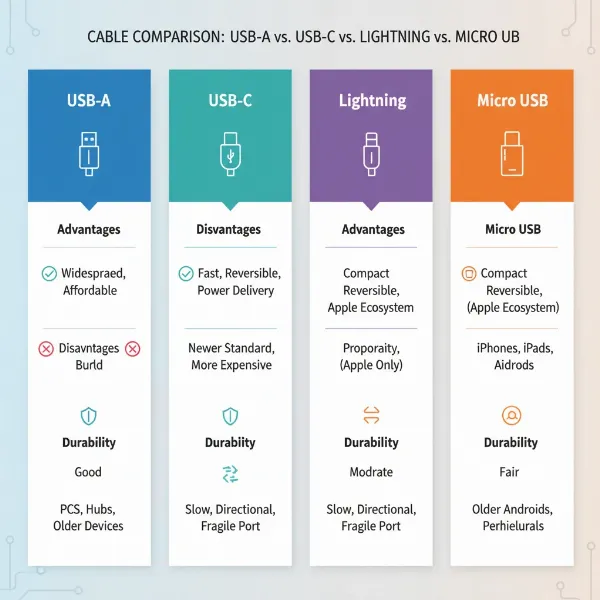
Understanding the differences between common cable types is essential, especially when focusing on computer protection. While USB-A and Micro USB have largely been superseded for primary computer charging, USB-C and Lightning remain relevant in specific contexts. Here’s a comparison table highlighting their key attributes from a computer protection standpoint:
Detailed comparison table
| Criterion | USB-A to USB-C/Micro USB | USB-C to USB-C | Lightning to USB-C/USB-A | Thunderbolt 4 |
|---|---|---|---|---|
| Primary Use for Computers | Older peripheral connections, slow charging | Modern laptop charging, data, video | Apple accessories, limited computer charging | High-performance laptop charging, data, video, security |
| Max Power Delivery | Up to 15W (standard) | Up to 100W (SPR), 240W (EPR) | Up to 20W-30W (for devices) | Up to 100W (required), 240W (EPR) |
| Max Data Speed | Up to 480Mbps (USB 2.0) | Up to 40Gbps (USB4) | Up to 480Mbps (USB 2.0) | Up to 40Gbps (guaranteed) |
| Safety Features | Basic, depends on charger | PD negotiation, E-marker chips, over-temp protection (with certified cables) [1.3, 1.5, 2.3] | Basic, depends on charger/device | PD negotiation, E-marker chips, DMA protection [2.1, 2.2, 2.4], strict certification |
| Durability | Varies, often basic | High quality models are very durable, often braided [1.5] | Varies, known for fraying at ends | Highly durable, rigorous certification |
| Compatibility | Broad for older devices | Universal for modern devices | Exclusively Apple devices | Universal USB-C, backward compatible with TB3/USB4 [2.1, 2.3] |
| Computer Protection | Minimal inherent protection beyond basic charging | Good, with certified cables protecting against overcurrent/unstable power | Minimal inherent protection | Excellent, with advanced data security and power regulation |
For protecting your computer, USB-C to USB-C and Thunderbolt 4 cables are the clear frontrunners. USB-C with Power Delivery and an E-marker chip provides robust protection against electrical damage, ensuring your device receives the precise power it needs [3.4]. Thunderbolt 4 elevates this with even stricter certification requirements and built-in DMA protection, offering an unparalleled level of security against both power-related issues and potential data vulnerabilities, making it the best charging cable for protecting your computers in advanced use cases [2.1, 2.2, 2.4].
Detailed Charging cable buying guide
Choosing the best charging cable for your computer is an investment in its health and longevity. Follow this detailed guide to make an informed decision that safeguards your valuable equipment.
Determine usage needs
Before diving into specifications, assess your primary usage. Are you looking for a cable solely for charging your laptop at home, or do you frequently use public charging stations where data security is a concern? Do you need rapid charging for a high-powered workstation, or is a standard charge sufficient?
- Device Type: Identify the exact ports on your computer (e.g., USB-C, Thunderbolt). Most modern laptops use USB-C.
- Power Requirements: Check your laptop’s power adapter wattage (e.g., 60W, 100W, 240W). Your cable must support at least this wattage for optimal performance and safety [1.3].
- Data Transfer Needs: If you transfer large files or connect external displays, a cable with higher data bandwidth (like USB 3.2 Gen 2 or Thunderbolt 4) is essential [1.3, 2.1, 2.3].
- Public Charging Security: If you often plug into public USB ports, a “charge-only” USB-C cable or a USB data blocker can prevent “juice jacking,” a security exploit where hackers can access data or install malware [1.1, 1.2, 1.4]. These physically disconnect the data pins, ensuring only power is transferred.
Research reputable brands
Opting for cables from well-known and reputable brands significantly increases your chances of acquiring a safe and durable product. Brands like Anker, Belkin, Plugable, and OWC are recognized for adhering to stringent manufacturing and safety standards. These companies typically invest in quality materials, rigorous testing, and proper certification, translating to cables that offer consistent performance and superior protection for your computer [1.3, 1.5, 2.5, 4.1]. Avoid generic or no-name brands, as they often cut corners on safety features and material quality, which can lead to unstable power delivery, overheating, and even severe damage to your device [4.1, 4.4].
Check technical specifications and safety certifications
This is arguably the most critical step for computer protection. Always scrutinize a cable’s specifications and look for key safety certifications:
- USB-IF Certification: Look for the official USB-IF (USB Implementers Forum) trident logo on the cable or packaging [1.3]. This certification indicates the cable has passed compliance testing for voltage regulation, data integrity, and thermal management, ensuring it adheres to industry standards.
- Power Delivery (PD) & Extended Power Range (EPR): Confirm the cable supports the PD wattage required by your laptop (e.g., 60W, 100W, 240W). For anything over 60W, ensure the cable contains an E-marker chip [1.3, 2.3]. This smart chip communicates the cable’s power capabilities to connected devices, dynamically negotiating safe power levels and preventing potential damage from overcurrents [1.3, 3.4].
- IEC & UL Standards: Compliance with international safety standards like IEC 62368-1 (for audio, video, and ICT equipment safety) and UL 9990 (for communication cable safety) is vital, especially for high-power USB-C cables (100W-240W EPR) [2.1, 2.2, 2.3, 2.5, 3.1]. These certifications verify the cable’s ability to withstand high voltage and prevent fire risks.
- Thunderbolt Certification: For Thunderbolt cables, ensure they are certified, ideally Thunderbolt 4, as this guarantees a stricter set of capabilities, including universal 40Gbps speeds, 100W charging, and Intel VT-d-based DMA protection for enhanced data security [2.2, 2.4, 2.5].
Verifying these specifications and certifications helps ensure that the cable you choose is not only functional but also engineered to protect your computer from electrical hazards and security threats. A small saving on an uncertified cable is not worth the risk of a costly computer repair.
Top charging cables for protection and performance
When it comes to selecting the best charging cable for protecting your computer, the focus shifts from generic options to specialized, certified solutions that prioritize both electrical safety and data security. While specific models can vary, the categories below represent the pinnacle of protection and performance.
For comprehensive electrical safety and efficient charging, always choose Certified USB-C Power Delivery (PD) cables that match or exceed your laptop’s wattage requirements. Look for cables with an integrated E-marker chip, especially if your laptop draws more than 60W. Brands like Anker, Belkin, and various USB-IF certified manufacturers offer excellent options that ensure stable power delivery and protect against overcurrents and overheating. The Belkin BoostCharge 240-watt cable, for instance, is noted for its dual eMarker chips and over-temperature protection, signaling devices to pause charging if overheating is detected [1.5].
For users seeking the utmost in data security and robust performance, Thunderbolt 4 certified cables are highly recommended. These cables are not only guaranteed to support 40Gbps data transfer and up to 100W (or 240W EPR) charging but also incorporate mandatory Intel VT-d-based Direct Memory Access (DMA) protection. This feature actively safeguards your computer against malicious attacks, making them superior for protecting your data while connected to various peripherals or public docks [2.1, 2.2, 2.4]. Companies like OWC and Cable Matters offer Intel-certified Thunderbolt 4 cables that meet these rigorous standards [2.3, 2.5].
Finally, for those who frequently use public charging ports, USB-C “charge-only” data blocker cables or adapters are an indispensable security investment. Products like the Plugable 240W USB-C data-blocking cable are specifically designed without data lines, allowing only power transfer and effectively preventing “juice jacking” – the exploit where public charging stations can steal data or install malware [1.1, 1.2, 1.4]. These cables provide a physical “air-gap” for your data, offering peace of mind when you need to power up in vulnerable environments [1.4].
Prioritizing these categories and verifying their respective certifications will ensure you choose a charging cable that not only powers your computer efficiently but also provides robust protection against both electrical and digital threats.
Conclusion
Choosing the right charging cable for protecting your computers is a critical decision that extends beyond mere functionality. We’ve explored how a quality charging cable, especially certified USB-C Power Delivery and Thunderbolt 4 options, plays a vital role in safeguarding your device from unstable voltage, overcurrents, and even sophisticated cyber threats like juice jacking. Key features such as E-marker chips, robust materials, and compliance with rigorous safety standards like USB-IF, UL, and IEC are indispensable for ensuring your computer receives clean, stable power and remains secure. Investing in cables from reputable brands and verifying their certifications is a proactive step in preserving your laptop’s performance and prolonging its life. Don’t let a seemingly simple accessory compromise your valuable technology. What steps will you take first to secure your charging setup and protect your computer?
Frequently Asked Questions
What is juice jacking and how can a charging cable protect against it?
Juice jacking is a security exploit where public USB charging stations are compromised to install malware or steal data from connected devices [1.4]. A “charge-only” USB-C cable or a USB data blocker protects against this by physically disconnecting the data pins, allowing only power transfer while blocking any data communication [1.1, 1.4].
Do all USB-C cables offer the same level of protection for laptops?
No, not all USB-C cables offer the same level of protection. While the connector is standard, the internal components and certifications vary greatly. High-quality, certified USB-C PD cables with E-marker chips provide superior electrical protection, while generic cables often lack these safeguards, risking unstable power delivery and device damage [1.3, 4.1].
How do I know if a charging cable is certified for safety?
Look for official certification logos on the cable or its packaging, such as the USB-IF (USB Implementers Forum) trident logo. For higher power cables (over 60W), ensure it specifies Power Delivery (PD) capabilities and mentions an E-marker chip. Compliance with UL and IEC safety standards also indicates a rigorously tested product [1.3, 2.1, 2.5, 3.1].
Can a cheap charging cable damage my computer’s battery?
Yes, a cheap charging cable can significantly damage your computer’s battery. Low-quality cables and chargers often lack proper voltage regulation and protection mechanisms, leading to unstable current delivery, overcharging, and overheating. This accelerates battery wear, degrades its health, and can cause issues like battery swelling [4.1, 4.4].
What is an E-marker chip and why is it important for charging cables?
An E-marker chip is a small electronic chip embedded in high-wattage USB-C cables (typically over 60W). It communicates the cable’s power capabilities to connected devices and chargers. This negotiation ensures safe power delivery, preventing dangerous overcurrents to devices that cannot handle high wattages, and can also provide over-temperature protection [1.3, 1.5, 2.3, 3.3].
Is Thunderbolt 4 safer than Thunderbolt 3 for my laptop?
Yes, Thunderbolt 4 is generally safer than Thunderbolt 3, particularly concerning data security. Thunderbolt 4 mandates Intel VT-d-based Direct Memory Access (DMA) protection, which safeguards against direct memory attacks. It also features stricter certification requirements, ensuring consistent performance and higher safety standards across all certified devices and cables [2.1, 2.2, 2.4].
How can I protect my charging cable from physical damage?
Protect your charging cable by avoiding tight wrapping, which stresses internal wires [4.5]. Coil it loosely and store it in a way that prevents kinking or bending at sharp angles, especially near the connectors [4.5]. Keep it away from sharp edges, water, and pets. Always unplug the cable by gripping the connector head, not by pulling the cord itself [4.2, 4.5].